Springdallah: what several family collections can reveal together
A study of a small Victorian goldfield shows how certificates, land records and material held by local families can reconstruct a whole community rather than a parade of famous names.
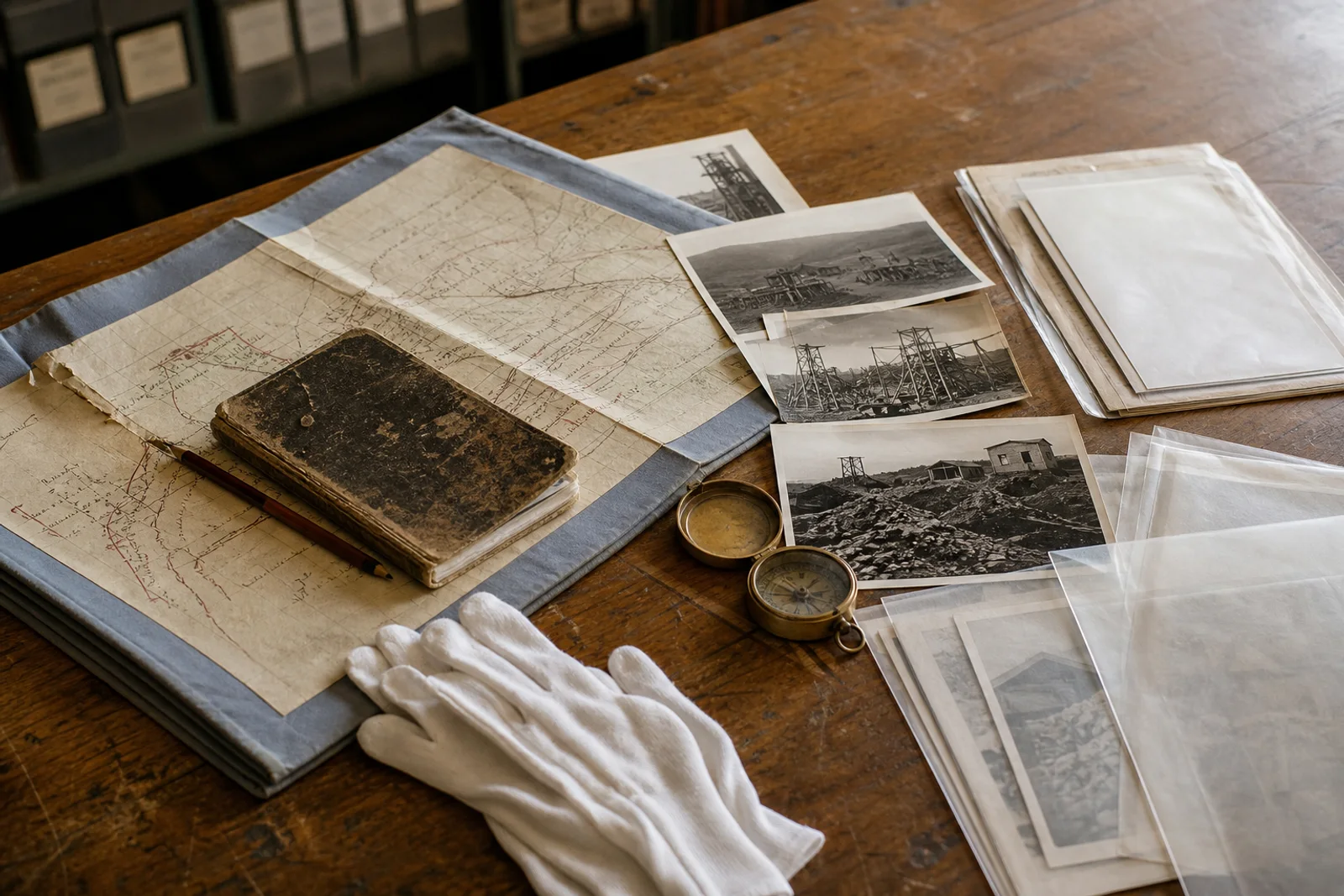
A PROV journal article on Scots at Springdallah used linked biographical research and a large family-held collection of certificates to study a goldfield community. It demonstrates the network effect Mines & Quarries wants to create: separately modest family records become more informative when names, places, dates and sources can be compared.
Small fields need networked evidence
The public history of a small field is easily flattened into a discovery date and several company names. Families experienced something wider: seasonal work, farming, engine driving, stores, school, transport, marriage and movement between nearby settlements. No single record series was created to preserve that system.
A PROV Provenance article about Scots at Springdallah and Piggoreet shows what becomes possible when biographical and local records are linked. Its evidence included a database built substantially from a family-held collection of birth and death certificates relating to the district. The article uses multiple people and occupations to study a community rather than treating one famous individual as its history.
A certificate collection can become an index
A certificate is evidence about one event, supplied under a particular administrative process. A group of certificates can reveal repeated addresses, occupations, witnesses and family links. When those fields are transcribed consistently, the collection becomes an index that can point toward land files, newspapers, cemetery records, directories and mine records.
That does not make every relationship automatic. Name variants, reused given names and uncertain informants must stay visible. The responsible workflow preserves an image or archive reference, transcribes what the document says, separates interpretation into another field, and records the person who made the identification.
The missing workers around the mine
Local mining histories often over-represent mine owners and managers because company and government records preserve their names. Families can restore less visible roles: engine drivers, carters, gardeners, storekeepers, domestic workers, children and people who combined mining with agriculture. Their work made a settlement function even when it does not appear in a production table.
A submission should not force every ancestor into the category of “miner”. Exact occupational wording is useful. So is uncertainty: “family says he carted for a mine, company unknown” is an honest lead that can be tested. It is more valuable than a confident claim made to sound important.
Build a locality file families can correct
Mines & Quarries can connect contributions by locality, name, date range and source without publicly exposing private contact details. Accepted material can be credited to a person, family collection or institution. A disputed identification remains labelled; an item with unclear rights can inform research without being reproduced.
The invitation is deliberately small: send one name and one source reference, or describe one object and the chain by which it reached the present custodian. Enough small, well-described records can produce a community history that no single family was expected to write alone.
Could your family add the missing line?
Do you hold certificates, school names, property references or photographs from Springdallah, Piggoreet, Smythesdale or another small field?
Send a description, the source or catalogue reference you already have, and what you believe it changes. Nothing is automatically published. Do not send original physical material.
Share a note or source →Before you contribute
Why collect records from several families?
Shared names, addresses, witnesses and occupations allow records to be cross-checked and placed in community context.
Must an ancestor have worked underground?
No. Transport, domestic work, commerce, farming and many other roles sustained mining settlements.
Can an item be indexed but not displayed?
Yes. Rights or privacy may permit a descriptive record without public reproduction.
How are uncertain identifications handled?
They remain labelled as tentative or disputed until stronger evidence is found.
- [1]Public Record Office Victoria — The Scots at Springdallah
- [2]National Archives of Australia — Caring for a personal collection
- [3]National Library of Australia — Trove people and organisations
- [4]Oral History Australia — Guidelines for ethical practice
This article summarises public sources and identifies research gaps. It does not claim a relationship with the named families, repositories or interviewees, and it does not reproduce restricted collection material.